IIT Delhi partnered with Dograh to automate Alumni Day invitations, replacing time-consuming manual outreach across batches from 1966 to 2025. In just one week, Dograh handled alumni invites, captured RSVPs with family counts, answered common queries, and collected peer referrals efficiently.
This guide explains the workflow we used, what we learned, and what I would recommend to other alumni associations.

The Alumni Day Invite Problem IIT Delhi Wanted to Fix
A flagship alumni event needs flagship outreach, but the team size doesn't scale with the ambition.
Why Alumni Day matters (1966 to 2025 batches, flagship event)
IIT Delhi Alumni Day is not a small meetup. It is organized to bring together alumni across batches from 1966 to 2025 for a shared celebration.
For 2025, the scale mattered even more. The 12th IIT Delhi Alumni Day was planned for Sunday, 21 December 2025, at the IIT Delhi campus.
What was new this year was the mix. It included meetups and nostalgia, plus:
- Cultural events like standup and poetry.
- Meetups across batches and interests.
- A Start-up Expo where startups could showcase, connect with peers, VCs and mentors, and pitch for a grant (as shared by the organising team).
The Hard Part : Inviting at Scale with a Small Team
The IIT Delhi Alumni association has a large alumni base. Every year, inviting everyone is the hard part.
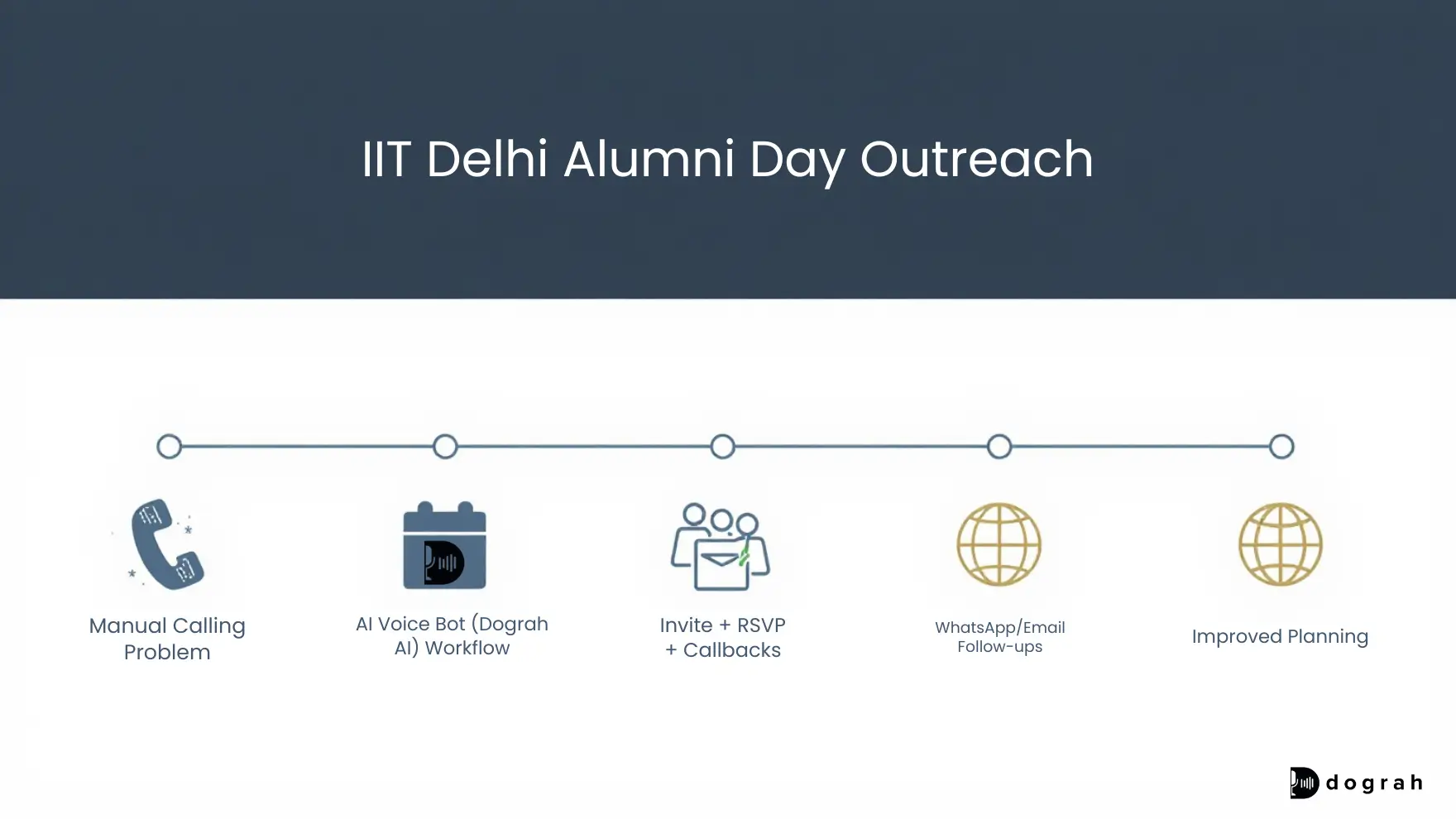
Before Dograh, the outreach was mostly manual. Volunteers would call alumni, and the alumni cell would try to cover as many contacts as possible.
But the constraints were real and hence the result was predictable. Most alumni could not be reached each year due to human and resource constraints.
What Dograh was brought in to do (Invite + RSVP + referrals)
The system needed to do more than "just invite":
- Boost registrations and attendance.
- Collect RSVP so the team could plan capacity better.
- Handle common questions about the event on the call.
- Ask whether family members would join (headcount matters).
- Ask alumni to share the invite in batch groups and peer circles.
- Schedule callbacks when the alum was busy.
What is AI calling
AI calling is when a voice agent makes or receives phone calls and can hold a short, natural conversation to complete a task.
Here, the task was simple to contact a large alumni base, capture RSVP, check if family attending, ask for spreading word, manage polite callbacks and send written follow-ups efficiently.
Myths about AI Calling for Alumni Outreach (and What happened in reality)
AI calling works when it is designed to approach clients (alumni) with respect, clarity and short conversations.
Myth 1 : “AI calls feel rude by default”
Reality : Tone, Voice and conversational structure decide this. Dograh used a polite opener, clear identity confirmation and a fast opt-out.
Myth 2 : “AI cannot handle questions”
Reality : Dograh AI Voice agents can handle up to 80% of predictable questions. We trained the agent with event details and FAQs, and smoothly redirected edge cases to written follow-ups.
Myth 3 : “AI cannot schedule callbacks reliably”
Reality : Callback scheduling works when it is built into the workflow. The Dograh agent captures preferred time slots, schedules callbacks automatically and tracks completion end-to-end.
Event + Audience details that Shaped the Outreach Plan
The large number of audiences (alumni) around the country and their language decide everything from script length to speech recognition choices.
Who we had to reach: Wide Alumni range and Hinglish needs
The audience span nearly 60 years of alumni: 1966-2025 batches.
That range changes how people respond:
- Older alumni often prefer phone calls and short, respectful conversations
- Younger alumni are fine with calls but often ask for details on WhatsApp or email
- Many alumni switch languages mid-sentence, especially into Hinglish
- Indian names and accents create extra complexity for voice systems
So we designed for real Indian speech, not "demo English".
Careful choices were made in Dograh’s speech components:
- Optimised for low WER (word error rate) in Hinglish-heavy speech
- Used voices that sounded familiar with an Indian accent
- Focused on correct pronunciation for Indian names and campus terms
- Supported Hindi + English + Hinglish switching naturally
As shared by the project team, reasoning was supported by Dograh's own LLM (a fine-tuned open-source model) designed for voice use cases and better tolerance to transcription errors.
What the Invitation had to Communicate (simple event facts)
Every call had to deliver the essentials quickly:
- Event: 12th IIT Delhi Alumni Day
- Date: Sunday, 21 December 2025
- Venue: IIT Delhi campus
- Purpose: Alumni reconnect, batch meetups, community celebration
- What else: cultural events + Start-up Expo
- Actions needed: RSVP + family count + referral ask (share with peers)
As per use case the voice bot kept the event pitch short. The call's main job was RSVP.
Channels used together: Voice AI + WhatsApp + email
Voice calls were the primary channel because:
- Calls get attention faster than emails in high-noise inboxes
- Many alumni do not respond to forms unless prompted
- A call can ask one question at a time, which increases completion
But voice alone is not enough. Calls were backed with written channels:
- WhatsApp for event details and reminders
- Email for formal event info and reference
This combination reduced friction. The call created intent. Written messages carried details.
Glossary (Key terms used in this case study)
- Hinglish: A natural mix of Hindi and English in the same sentence. Common in Indian phone conversations.
- STT (Speech-to-Text): Converts what the alum says into text so the agent can understand.
- TTS (Text-to-Speech): Converts the agent's reply into spoken audio.
- WER (Word Error Rate): A measure of transcription accuracy. Lower WER means fewer mistaken words.
- Opt-out: A clear way for the recipient to stop future calls or messages.
Why the old process did not scale (and what Dograh did differently)
Manual calling is good work, but it becomes tedious when the list is large and time is short.
Before Dograh: Manual Calling by Volunteers (limits and gaps)
The previous approach relied on volunteers calling alumni.
It worked for some coverage, but the same gaps returned each year:
- Volunteers cannot call at scale for weeks
- Follow-ups depend on personal discipline and spare time
- Notes get inconsistent across callers
- RSVP capture becomes messy without a single system
This was not about effort. It was about limited human time.
Key Constraints: time, budget and planning uncertainty
The organising team faced practical issues:
- Hard to reach alumni at the right time
- Outreach becomes effort-heavy and expensive if scaled manually
- Low RSVP certainty makes capacity planning difficult
- Follow-ups are missed because there is no automation loop
- Busy alumni do not get a clean callback option without extra manual work
What success looked like (clear, measurable, but non-confidential)
Dograh’s voice bot success was measured using clear, trackable KPIs, while keeping all sensitive metrics and numbers confidential.
The team tracked:
- Pickup rate: How many calls were answered
- RSVP confirmations: yes/no/maybe captured clearly
- Callback completion: Scheduled callbacks that actually got completed
- Referral intent: Whether alumni agreed to share in peer groups
- Turnout quality: Fewer last-minute surprises because RSVPs were clearer
What is a multi-agent voice workflow
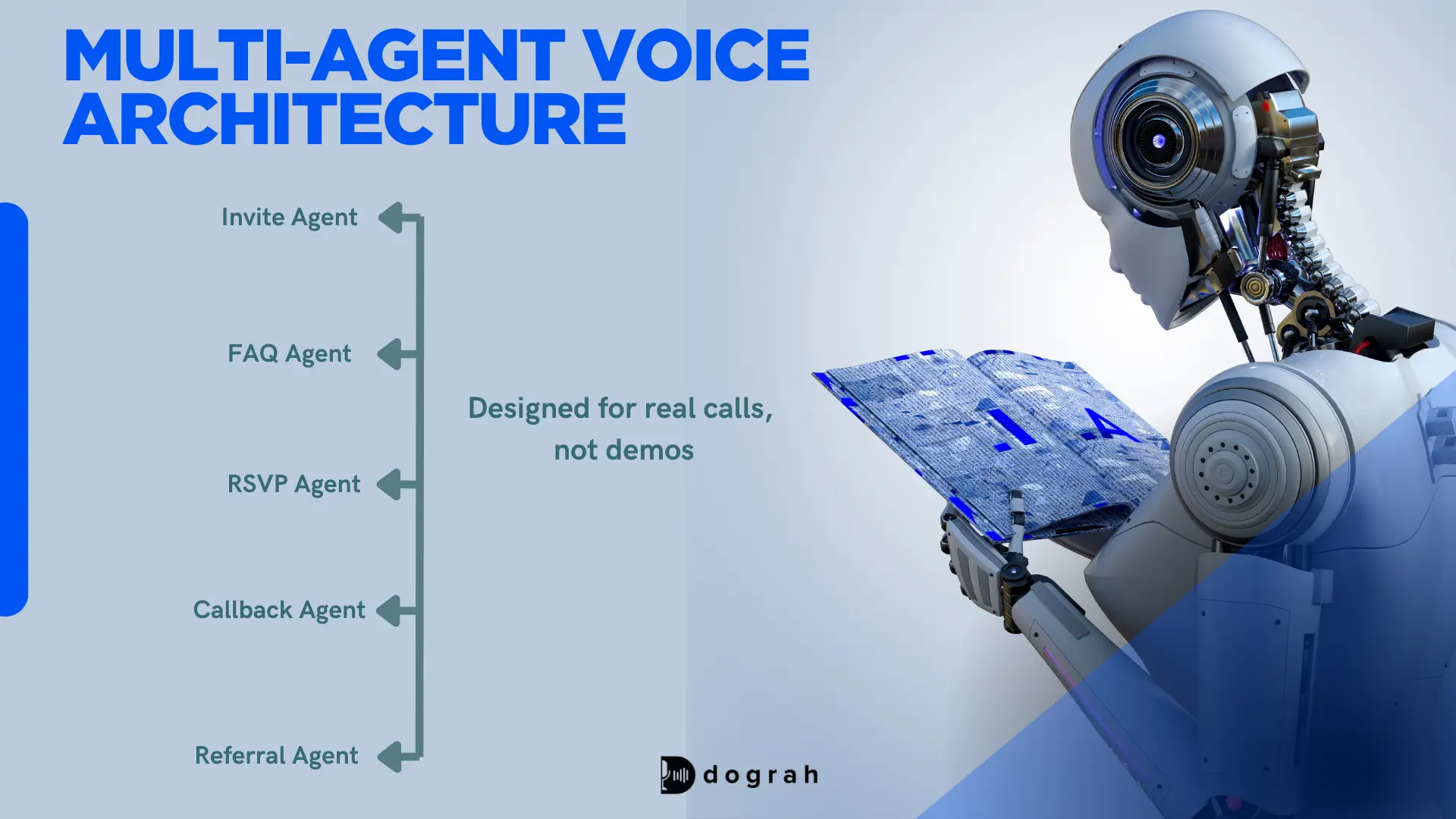
A multi-agent voice workflow splits a conversation into small jobs, each handled by a focused sub-agent.
That matters in real calls because:
- Invitations are not the same as RSVP capture
- RSVP capture is not the same as FAQs
- Callback scheduling needs tight logic and confirmation
This structure reduces drift and keeps the call on-message.
Conversation design: multi-agent script in Hindi + English + Hinglish
We designed the bot to behave like a short, polite caller.
The agents handled distinct parts:
1. Identity + permission agent
- Confirm and communicate details
- Immediate exit if they do not want calls
2. Event invite agent
- State IIT Delhi Alumni Day context
- Share date and campus venue
- When relevant, mention what is new this year (cultural events + Start-up Expo)
3. FAQ agent
- Handle common questions like "What's the schedule?" or "Is family allowed?"
- Trigger WhatsApp/email follow-up for details
4. RSVP + capacity agent
- Capture yes/no/maybe
- Capture family count where relevant
5. Referral agent
- Ask if they can share in batch group or peer group
- Keep it zero-pressure
6. Callback agent
- Offer a callback time
- Confirm a slot
- Log it and execute later
Language handling was core.
- Many alumni started in English, then moved into Hindi
- Hinglish often appeared when explaining availability
- Proper nouns (names, departments) needed strong STT performance
RSVP capture + family members + referral ask (in one flow)
The call flow was designed to complete the job in one pass.
Here is the structure we used:
- Invite to Alumni Day
- Ask if they are interested in attending
- Capture RSVP: Yes / No / Maybe
- If Yes/Maybe: ask if family members may join
- Capture approximate family count (for capacity planning)
- Ask if they can share the invite with batch peers
- Offer to send details on WhatsApp/email
This kept the conversation short, engaging while still collecting what the alumni cell needed most.
Busy alumni handling: Polite exit and scheduled callbacks
Many alumni answered but were busy.
So the bot was trained to detect "busy now" cues like:
- "In a meeting"
- "Call later"
- "Driving"
- "Not now"
Then it moved into a respectful path:
- Ask for a preferred callback time
- Confirm the time clearly
- End the call quickly
- Schedule and complete the callback later
The goal was courtesy and reliability, not persistence.
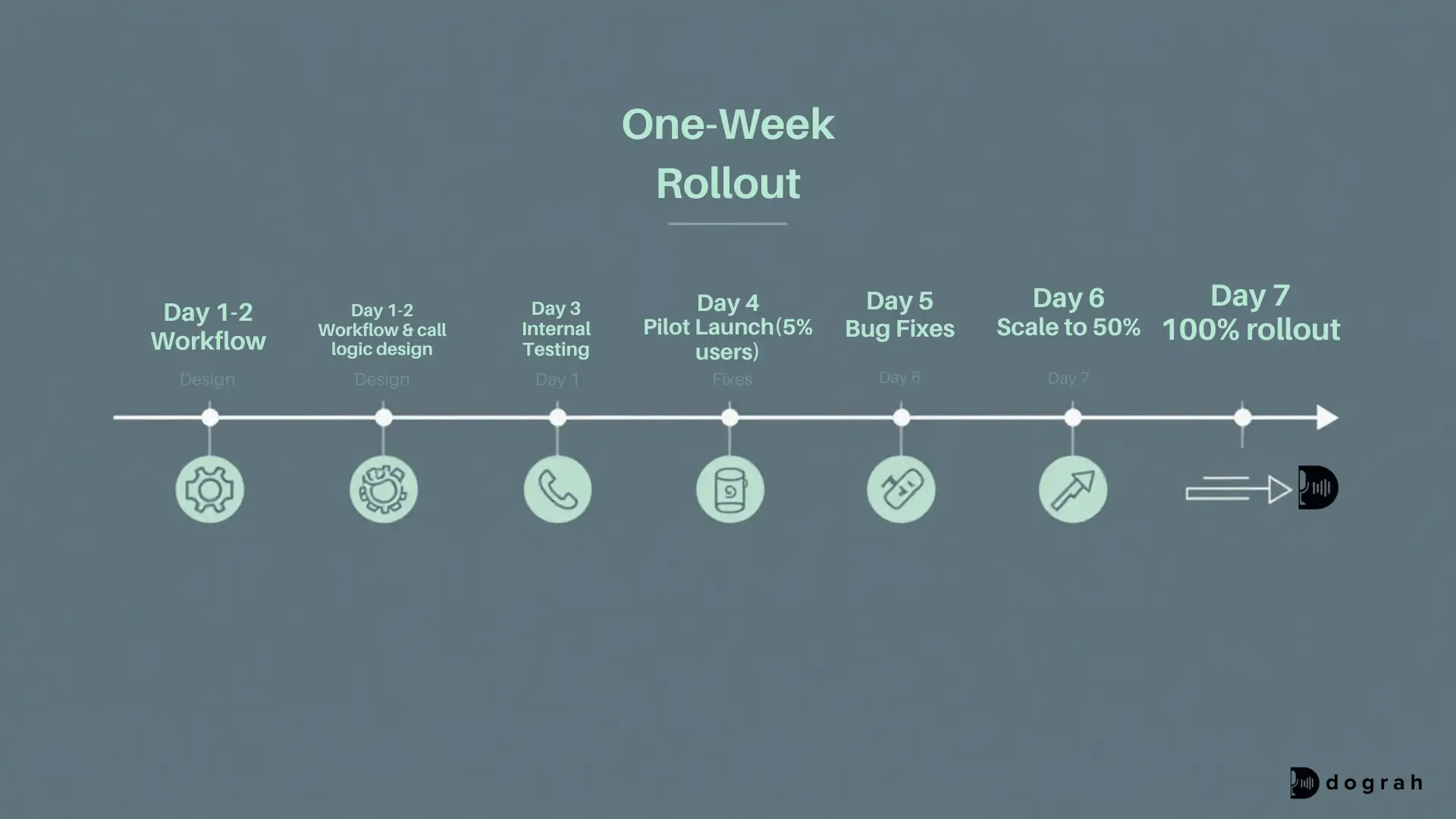
Fast rollout in one week: testing, tags, and continuous fixes
A one-week timeline by Dograh enforced discipline, enabling rapid testing, fast learning and quick iteration to ship reliably.
Internal testing with the organising committee (first failure points)
The voice bot started internal test calls with organising committee members. To track down early issues.
This surfaced issues early:
- Where the opener sounded unclear
- Where alumni might doubt authenticity
- Which details people asked for repeatedly
- Where the bot spoke too much
- Where language switching created confusion
This phase prevented avoidable failures on real alumni calls.
Evals set + call tags: how we learned from every call
We created an evals set from early trials and kept expanding it.
An evals set is a repeatable checklist of call scenarios and includes exact conversation turns and statements, for scenarios like:
- "Alum is busy and asks for callback"
- "Alum asks for details in writing"
- "Alum is unsure and says maybe"
- "Alum wants to bring family"
At the same time, every call generated tags.
These tags summarised what happened in the call and what went wrong, using call analysis with an LLM plus a human-in-the-loop review pipeline.
Examples:
- "Busy_request_callback"
- "Needs_whatsapp_details"
- "Language_switch_hinglish"
- "FAQ_startup_expo_question"
- "Bot_missed_identity_confirmation"
This loop made iteration fast:
Test > tag > fix > retest > scale
Phased rollout: 5% pilot > edge cases > full weekend launch
We did not go from zero to full volume.
We followed a controlled rollout:
- Start with a 5% pilot of the alumni base
- Review tags and transcripts for new objections
- Patch the workflow for edge cases
- Retest on the evolving evals set
- Then scale up over a weekend launch
This approach reduced risk while improving stability and giving greater control over the workflow.

Results and Impact: Better planning, Stronger buzz, Higher turnout
Better outreach is not only about more calls. It is about better planning and smoother operations.
What improved
Exact numbers can’t be shared (confidential), but the following outcomes showed clear improvement:
- Higher pickup rates and RSVP completion, driven by the voice bot reaching out at times and days when alumni were observed to be more receptive.
- More completed callbacks because callback scheduling was built into the flow.
- Clearer capacity planning because RSVP and family intent were captured consistently.
- Smoother coordination for the alumni cell because the workflow created a single RSVP stream.
- Stronger peer-group buzz because the referral ask was part of every successful invite.
- Healthy/Engaging conversation through careful STT selection to reduce WER in Hindi, English, and Hinglish, along with the right TTS to pronounce Indian names accurately and deliver a familiar Indian accent.
Alumni response: why the approach was well received
The approach was well received for straightforward reasons:
- Calls were quick and polite
- The agent was multilingual and handled Hinglish naturally
- Alumni got the key info without searching for it
- The alumni team managed a tough outreach job without expanding headcount
- Word-of-mouth moved inside alumni groups because people were asked to share
Peer groups are the main distribution channel for alumni events, so this mattered.
Top Objections and How the bot handled them ?
Objections were predictable, which helped automation.
The voice bot did not argue or push, making it easy for alumni to respond.
What Made this Work: Playbook for Alumni associations and Campuses
If you want similar results, design for respect, short calls, and clean operations.
Timing and targeting: Calling windows that respect alumni schedules
Better pickup rates are often a scheduling problem, solved through timing analysis.
Practical rules that worked for us:
- Call in predictable windows when people are free
- Avoid very early mornings and late nights
- Keep retries limited and spaced out
- Do not call too frequently if there is no response
- Keep the first call short and offer written details
Also, plan for callbacks. Busy answers are leads.
Script rules: clarity, trust, and zero pressure
The invitation script should be boring in a good way.
Use these rules:
- State the IIT Delhi Alumni Day context clearly
- Confirm identity quickly and politely
- Share date, venue, and what is new in one breath
- Ask for RSVP in a yes/no/maybe format
- Ask about family only after RSVP intent
- Ask for referrals in a soft way
- Always give an easy opt-out
A simple 20-second opener template
"Hello, am I speaking with [Name]? I'm calling on behalf of IIT Delhi Alumni Day. We're inviting alumni for the 12th Alumni Day on Sunday, 21 December 2025 at IIT Delhi campus. Wanted to check if you would be able to make it?"
Operations checklist: what the alumni cell needs to prep
Prepare this before launching AI outreach:
- Final event basics: date, venue, major agenda points
- A short FAQ list (top 10 questions)
- Escalation contact for special cases
- WhatsApp and email templates for details
- Callback windows and rules
- A simple RSVP logging method (sheet/CRM)
- Opt-out policy and wording
- Internal test group for trial calls
Why we used Dograh (and how it kept us flexible)
Dograh worked here because the workflow needed speed, control, flexibility and trust- and Dograh was Open Source. My view: for university outreach, data control and flexibility matter as much as call quality, and Dograh covered both.
Fast build and fast edits: visual builder + plain-English changes
We had one week, so tooling had to be fast.
Dograh helped because:
- It is a drag-and-drop conversation builder
- You can edit workflows in plain English
- You can get a working agent running quickly and iterate
- Multi-agent workflow design keeps calls stable under real-world noise
Alumni calls are messy. People interrupt, switch languages, and ask unexpected questions.
Quality control: AI-to-AI testing (Looptalk) and ongoing evals
Dograh includes an AI-to-AI testing suite called Looptalk.
The idea is simple:
- Simulate different alumni personas
- Stress test the agent before large rollouts
- Catch failure modes early
- Keep expanding the evals set as new patterns appear
This reduces surprises when you move from pilot to full volume.
Open source and self-host options (for university trust and control)
Universities care about control and long-term trust.
Dograh is built as an open-source platform and can be self-hosted, which helps institutions that want:
- More transparency than closed platforms.
- No platform fee and hidden charges.
- Infrastructure control.
- Licensed under the BSD-2 Clause, allowing free use, modification and distribution with broad compatibility.
- The ability to bring user own stack and keys(STT, TTS, LLM, Telephony).
Dograh’s flexibility allowed careful STT and TTS selection to reduce WER across Hindi, English, and Hinglish, while accurately pronouncing Indian names with a familiar Indian accent, optimized for local speech patterns and strict data handling.
Prerequisites (if you want to run a similar AI RSVP rollout)
You can move fast if these basics are ready:- A verified alumni contact list (even if imperfect)
- Event facts: date, venue, key agenda highlights
- WhatsApp/email templates prepared in advance
- A clear RSVP logging destination (Sheet/CRM)
- A short FAQ list and escalation path
- A defined opt-out approach
Useful links (to explore Dograh)
If you are building something similar, start here:
- Dograh has a credits deal and support program for IITD alumnis building voice agents. Reachout to ITTDAA or email the founders at founders@dograh.com or schedule a demo.
- Read the Dograh documentation to understand workflow building and deployment.
- Explore the Dograh GitHub repository if you want self-hosting and open source visibility.
- Join as a beta user or contributor if you want early access and faster support.
Closing note
This project worked because the IIT Delhi team stayed focused on a simple goal, making invitations respectful, RSVPs easy, and planning predictable.
If you are running an IITD alumni meet, or any IITD annual day-style event, the playbook is the same.
Keep the call short. Make the RSVP action clear. Offer written details. Treat callbacks as a core part of operations. And do not overthink it, a disciplined workflow beats a fancy script.
FAQs
1. Was alumni data secure ?
Data was shared under NDA, only essential fields were collected, opt-outs were respected, and no unnecessary data was duplicated. The platform was self-hosted and fully encrypted, ensuring complete data control and security.
2. Why was open source important for this use case ?
Universities value transparency, long-term control, and the ability to self-host. Dograh’s open-source, BSD-2 licensed setup avoided vendor lock-in and hidden costs.
3. How long did it take to go live ?
The entire rollout, from workflow design to pilot and scale, was completed in one week through disciplined testing and phased deployment.
4. What happens if alumni don’t answer the call ?
Timing analysis and limited retries were used. Busy responses were treated as leads, not failures, and callbacks were offered politely.
5. Can this approach work for other universities or alumni associations ?
Yes. The workflow is reusable for any large alumni or community event where scale, RSVP certainty, and small teams are constraints.
