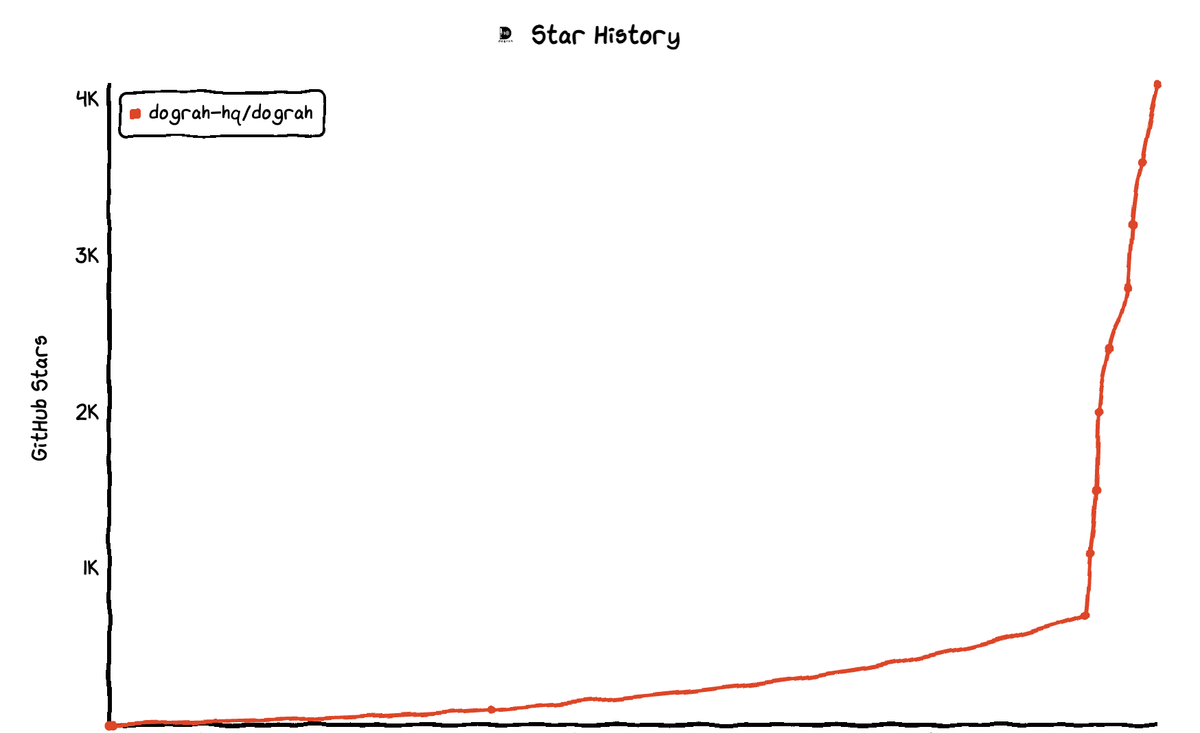
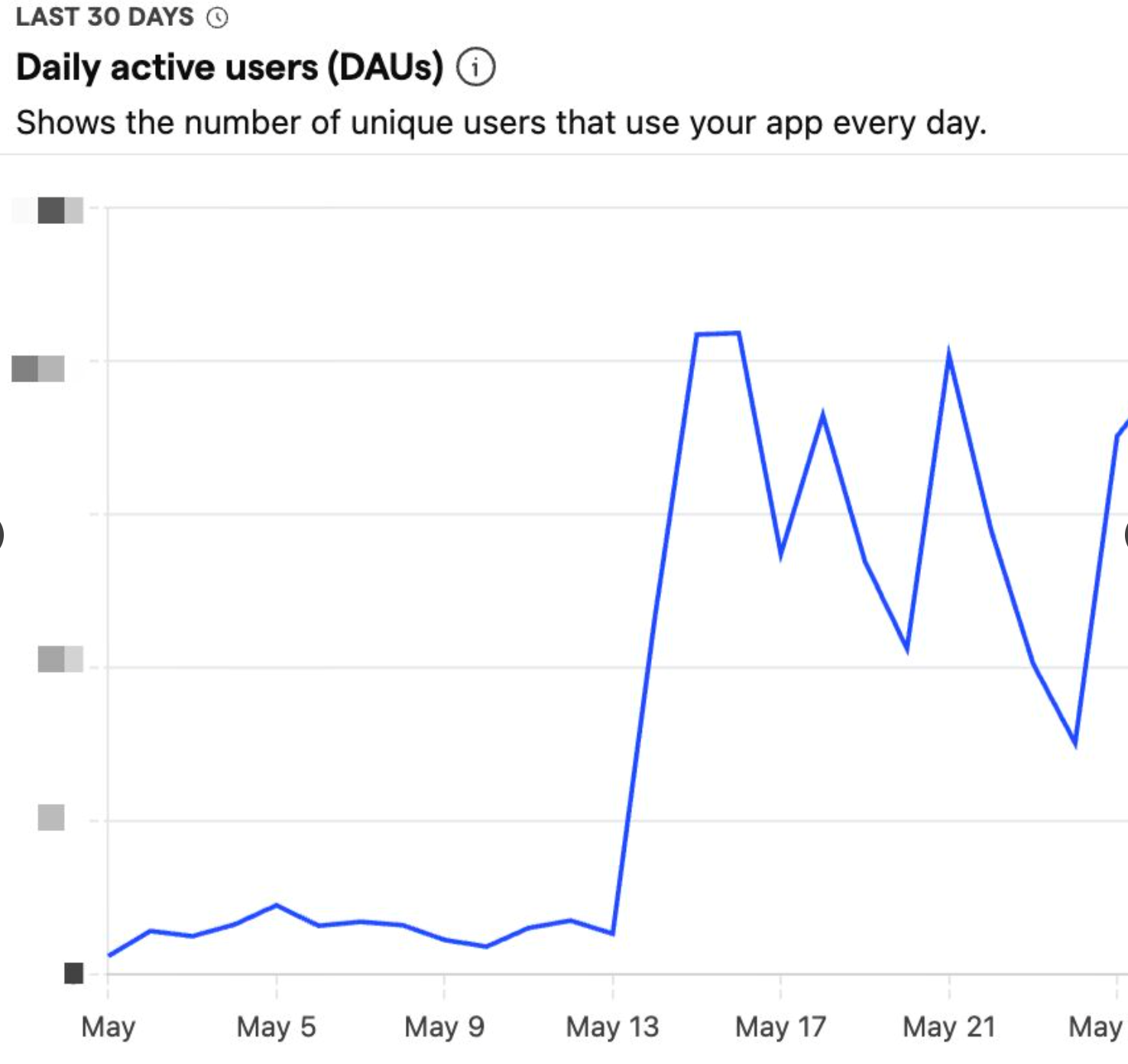
Quick context so that everything makes sense: Dograh is the open source alternative to Vapi, Retell, Bland etc. In the last 14 days our daily signups grew 20x and our GitHub stars went from 480 to over 4,100. Our cloud signups have gone up 20x. Zero ad spend, no agency, no paid creators.
I want to be straight about how this happened, because it would be easy to tell a clean story that makes us look smart. The truth is messier. We were running a lot of experiments, moving fast, and hoping one of them would catch. Most of them did not. A few did. This is the honest version of what worked, what did not, and the one big thing we still have not done.
If you want to skip the reading, just go try it. You can talk to a working voice agent for your own use case in under 90 seconds at app.dograh.com
The thing that actually started it: we open sourced everything and built it with our users
If I had to point at one decision that made all the growth possible, it was a promise we made to ourselves very early. We would open source every line of code we write, down to the last character. No held-back features, no secret cloud-only sauce.
That promise did two things. It made the platform genuinely powerful, because we kept pushing real capability into the open repo instead of hiding it. And it earned us real trust and real support from open source builders.
Then we did the part that mattered most. We started doing recurring weekly calls with a bunch of open source builders who were building on top of Dograh- standard YC advise to all their founders. Every week we would sit with them, hear what was breaking or missing, solve it, and then release that solution in OSS for everyone. A lot of our best features came straight out of those calls. Hybrid speech generation, where we mix real recorded human speech with a dynamic TTS fallback. Speech to speech support across the latest models. The ability to plug in your own self-hosted models. Support for powerful MCPs. We did not dream these up in a room. Our users asked for them, and we shipped them in the open.
Here is the part we did not expect. Because we were building for things nobody else was building for, the product picked up a bunch of unique angles. There were ways to build a voice agent on Dograh that you simply could not do anywhere else. That turned out to be a gift for creators. It gave them something fresh and powerful to show their audience, instead of the same demo everyone had already seen. Fresh content is easy to make and easy to share. So they made it.
If you take one thing from this whole playbook, take this. Build something people actually want by talking to the people using it, then keep adding so much value that talking about you becomes easy. That is most of the game.
The biggest driver: the community talked, and we helped every post win
So the real engine was simple. People started making content about Dograh, and we did everything we could to make that content succeed.
This did not come out of nowhere. We had been grinding on Reddit for six to seven months before any of this hit, slowly seeding discovery in the right communities. That long, boring groundwork is where our early community actually came from. Then a few people in that community started making YouTube videos and LinkedIn posts about us. We put our full weight behind them and helped a handful go viral, and that is what kicked off the flywheel. Over the last 14 to 15 days, we have had five to ten people a day talking about us across platforms, with almost no prompting from us.
The moment someone put out a video about us, we treated it like our own win. We reshared it on LinkedIn, across the relevant subreddits, on our GitHub, mailing list , personal groups and anywhere else we had a surface. Our only goal was to help that creator's post do well, because when their post did well, more people found Dograh. Some of those new people then made their own posts and videos. We helped those win too. Each turn of that loop pulled in a fresh wave, and each wave produced more creators than the one before. As a result we topped github trending charts thrice in last 2 weeks.
We also made one rule for ourselves and stuck to it. Support every content within the first 24 hours. The first day is when a content decides whether it lives or dies, because early engagement is what tells the platform to push it wider. So we watched for new mentions/videos constantly and jumped in fast with comments, shares, and upvotes. A post we backed on day one had a much better shot at going viral than one we stumbled onto a week later. Example: a video about Dograh by Betterstack got 100k views compared to their 10k average. Our own posts supporting that video got 200k+ views.

None of this was clever. It was just fast and consistent, every single day.
We gave creators free access and paid nobody
People keep assuming we paid for some of this. We did not. Zero spend was a real constraint and also a principle we held to (bootstrap anyone?).
What we did instead was give creators free access to the full platform and a direct line to our product updates. The more creators who tried Dograh and liked it, the more of them told their own audiences about it. Free access removed the only real barrier to them giving it a shot. Paying them was a line we chose not to cross.
That choice kept everything honest. When a creator talked about Dograh, it was because the product was worth talking about, not because money changed hands. Their audience could feel that, and it made the recommendation land harder.
The product had to wow in 90 seconds
All of the above sends people to one place, the product. So the product had to prove itself before anyone got bored.
We built Dograh so you can land on it, type in your use case, and be talking to a live voice agent for that use case in under 90 seconds. We killed so many things just to get this right. No setup wall, no long config, no reading docs first. The wow moment shows up while you are still curious.
This is quietly the most important thing on the list. If your product takes ten minutes to show value, most of your hard-won traffic leaves and never comes back. If it shows value in 90 seconds, people stick around, star the repo, and go tell someone. You can feel that 90 second moment yourself at app.dograh.com.
We built a small Reddit tool so we knew where to show up
One thing that saved us a lot of guessing was a little Reddit tool we built for ourselves.
It scans for posts that match our keywords and our target subreddits, then hands us a clean list of posts worth commenting on. It tells us which subreddits have the most voice AI and open source posts, so we spend time where the audience actually is. And it collects promotional launch posts that already went viral, so we can study what worked and borrow the shape of it.
We are sharing it so you can use it too: reddit-scanner
That tool is one of more than twenty automations we run internally, covering LinkedIn, PR, trend alerts, blog creation, a meeting to content assistant, WhatsApp scanners, and a pile of skills repos. Being this automation heavy set the tone for how we want the company to run. It also became one of our quieter mistakes, which I will come back to.
We wrote for AI search, not just Google
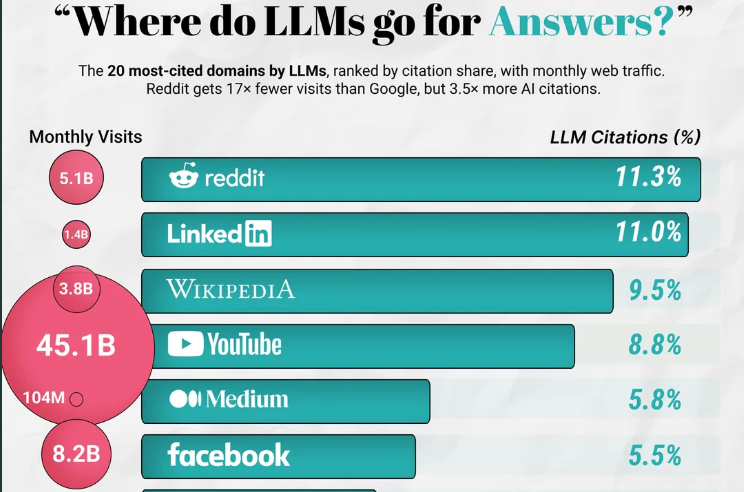
A big chunk of our discovery now comes from people asking AI tools for an open source alternative to Vapi or Retell or just about any Voice AI platform, and we show up on top. That was on purpose, and it sits on top of months of plain SEO work. I have deep hands-on experience in SEO, so we put serious effort into the fundamentals first, then layered GEO and AEO on top once we understood how AI tools actually pick what to cite. We treated GEO and AEO as real practices to internalize across everything we publish, not as a box you tick by dropping an llms.txt file and walking away. Now this is a full series of articles in itself (and htere's tonnes of content out there on how to do it right), but I will share some quick wins.
We did a couple of plain things. We published clean landing pages, because LLM search pulls a lot from clear, well structured pages. And we wrote blogs that follow a few rules that make AI tools want to quote us. Every blog has a glossary, a key takeaways summary at the top, and a bottom line in the first (BLUF) sentence of each section. Language models grab summaries and definitions really well, so writing that way gets us cited.
We also picked a keyword, "open source alternative to Vapi" and repeated it consistently. Not only on our homepage, but across our blogs, our YouTube videos, our Reddit posts, our dev.to articles, and everywhere else. When the same clear phrase shows up across a lot of trusted places, AI tools start to associate it with you.
One surface that surprised us is LinkedIn articles (different from LinkedIn posts). Articles let us go deep on Voice AI & Dograh, and over the last few months they have started getting a lot more reach than before. Most people are ignoring them right now, which is exactly why they work.
We cross-posted with other AI companies to build authority
Another thing that quietly helped was cross-posting with other voice AI and AI-native companies. When you keep showing up alongside other credible names in your space, both people and AI tools start to read you as one of the real players, and that authority signal compounds.
This one took a while to work, and the first attempt flopped. It started as a traffic swap group among a few of us YC founders, attempting to do social shoutouts and cross-blogging for each other. The group itself never really got off the ground adn we had zero posts (absolutely nothing). Instead of dropping it, we kept at the idea in a smaller way, and it slowly turned into one-on-one swaps with individual founders we knew well. Those one-on-one swaps are the ones paying off now. It is hard to put a clean number on it, but the lift is real. An additional nuance here- we did it with other Voice AI companies (in observability, payments etc)- which adds authoritativeness (massive for organic inbound).
A tailwind we did not engineer: enterprises want control of their data
One thing we keep noticing, is that a lot of our recent enterprise inbound shows up already worried about where their data goes. We hear some version of "we do not want our data used to train models" again and again, even from teams evaluating vendors that hold every compliance certification you could ask for. Voice makes the worry sharper, because so much personal information gets spoken out loud on a call (recall sharing credit card details and your DOB for verification?)
Our honest sense, and we know we are biased as the open source option here, is that trust across the whole category feels thinner than it did before LLMs. Any of us is probably one headline disaster away from a real dent in that trust. It just happens that being fully open and self-hostable answers a question enterprises are now asking on their own. We did not engineer this tailwind. We were just standing in a useful spot when it showed up.
Things we tried that were not the big unlock
I want to be real about this part, because the easy version of this story is wrong. We launched on Hacker News, and a lot of people assume that was the moment everything took off. It was not. The HN launch was fine, but it was not even in our top three drivers. It was one of many experiments we ran. Some experiments work, most do not, and you only find out by shipping them fast and watching what happens.
That is the actual method here, if you can even call it that. Move fast, keep momentum, run more experiments than feels reasonable, and stay close enough to your users that the wins compound. We got a little lucky too, and I would rather say that out loud than pretend we had a master plan.
The other honest failure is the automation habit I mentioned earlier. We built more than we can actually use. A good half of those twenty-plus tools now sit unused, like billboards we stop noticing, because we never had the bandwidth to work with them properly. We automated faster than we could operate. In hindsight I still go back and forth on how much of that we should have built ourselves versus simply bought off the shelf with an operator.
One of our biggest miss is that we still have not done a proper Product Hunt launch. We know it matters. We have held off because doing it right takes close to a month of prep, and we just have not carved out the bandwidth. I am mentioning it because a playbook that hides its gaps is not worth much. A clean Product Hunt launch is the next lever we plan to pull, and we are sharing the rest of this before we have everything figured out.
Go try it
Everything here points back to one idea. Build something people want, keep adding value, and help the people who like it spread the word. Dograh is the open source alternative to Vapi Retell etc, fully self-hostable, with a visual builder for voice agents and no per-minute middleman fees.
Talk to a live voice agent for your own use case in under 90 seconds at app.dograh.com. Star the repo and self-host it at github.com/dograh-hq/dograh.
And if you are growing an open source contributor, look at the open issues. We just got contributions from the Lyft (zimride) & June founder and 30 other contributors & teams last week.
Lastly join our slack to interact with the lovely OSS community.